|
"When you are courting a nice girl, an hour seems like a second. When you sit on a red-hot cinder, a second seems like an hour. That's relativity."
— Albert Einstein
“What is it with science these days? Everyone is so quick to believe in it, in all these new scientific discoveries, new pills for this, new pills for that. Get thinner, grow hair, yada, yada, yada, but when it requires a little faith in something you all go crazy.' He shook his head, 'If miracles had chemical equations then everyone would believe.”
― Cecelia Ahern, The Gift
CLICK ON BLOG to see the entries!
CLICK ON ABOUT to know me further!
CLICK ON ARCHIVES to see my list!
CHECK WHO'S ONLINE ON CHAT!
|
|
|
Saturday, May 1, 2010
sparkling star confession: scintillation
 why do stars sparkling? Star is an outer space object that potentially lights. Sun is a star. Star is more than a beautiful object. It embellishes our night and also history. In tarot card, star means hope. Its myriad meanings indirectly have embellished our living. Another example goes, when a pick-up liner goes a metaphor between a beautiful girl's eye and a star. Star as an outer space object, doesnt really spark. It looked sparkling if its light seen from far distance and when its light should through far distance air to our eyes. For example, astronauts in moon, which hasnt atmosphere layer, can see a night sky filled non sparkling stars. In our earth, a planet that filled with thick atmosphere, we can see stars spark or in more scientifical saying, "refracted".  Around us, air mass always flowing. Hot air moves toward up and vice versa. Air refracts light based on its density. So when starlight through thin air and goes through a thicker one, the light will refracted. The star will be look bigger and low resolutioned. Intensity changing is called scintillation . Labels: astronomy, light, physics, refraction, scintillation, sky, stars
|
|
|
Sunday, April 25, 2010
BLUE SKY AND RED SUNSET!
 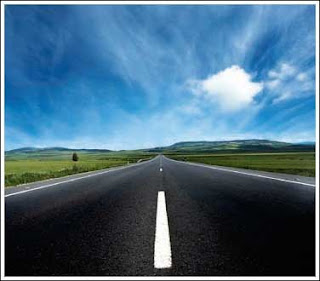 Why is the sky blue? What makes the sunset red? The sun produces color spectrum that blends into white lights. The colors are red, orange, yellow, green, blue, indigo and violet : a rainbow. These are the correspondent of different frequencies and wavelength of light energy. The seven colours of the spectrum all have different wavelengths and they are arranged accordingly. Violet, indigo and blue light have a higher frequency - which means shorter wavelength - than red, orange, and yellow light. When the white light from the sun shines through the Earth's atmosphere, it collides with gas molecules. Those molecules scatter the light. Blue light has a high frequency, and it is scattered ten times more than red light. But, the red light that you see from sunset is not scattered continues on in its original direction. When the sun is on the horizon (the sunset position), its light takes a longer path through the atmosphere to your eyes than when the sun is directly overhead. By the time the light of the setting sun reaches your eyes, most of the blue light has been scattered out. The light you finally see is reddish orange, the colour of white light minus blue. The dust and pollution molecules are also having role in this. Those molecules also scatter the light and make sunset more brilliant. Labels: colors, energy, light, physics, sky, sunset, wave
|
|
|


